
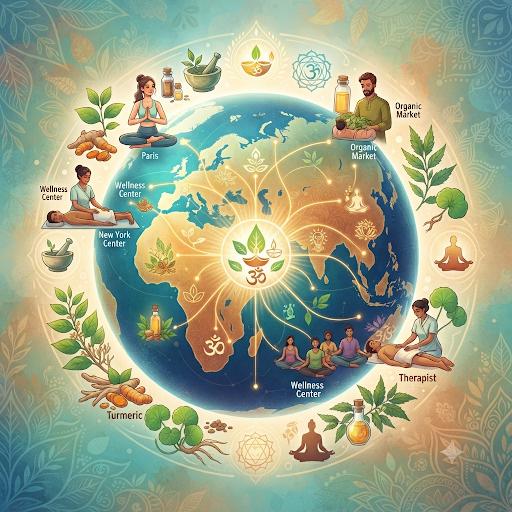
For centuries, Ayurveda was viewed primarily as a traditional system of medicine rooted in the Indian subcontinent. Today, it is transforming into a multi-billion-dollar global wellness movement.
Search trends reveal an unprecedented rise in global queries for terms like “herbal remedies for anxiety,” “Panchakarma detox,” “Ashwagandha benefits,” and “what is my Prakriti.” What was once considered alternative healthcare has stepped firmly into mainstream global culture.
- Global Adoption: Over 100+ countries practice Ayurvedic care, with formal recognition in more than 30 nations and WHO backing.
- Market Growth: Valued at over $24 Billion in 2026, driven by surging demand for natural, root-cause medicine.
- Core Philosophy: Focuses on preventive wellness, personalized body constitution (Prakriti), and root-cause healing rather than symptom suppression.
According to recent healthcare market studies, the global Ayurveda market size surpassed $20 Billion and continues to grow at an incredible compound annual growth rate (CAGR) near 19.7%.
While the Asia-Pacific region holds the largest market share, North America and Europe represent the fastest-growing regions due to rising consumer interest in plant-based supplements, organic skincare, and integrative medicine.
| Metric / Regional Focus | Data Insights & Growth Trajectory |
| Estimated Market Valuation (2026) | ~$24.3 to $24.5 Billion USD |
| Leading Product Segment | Herbal & Natural Formulations (~69% share) |
| Dominant Region | Asia-Pacific (Cultural heritage & high adoption) |
| Fastest-Growing Markets | North America & Europe (Integrative health & wellness tourism) |
Ayurvedic therapies, herbal preparations, and specialized retreats are now active in over 100 countries worldwide:
While modern allopathic medicine remains essential for emergency care, acute trauma, and surgical procedures, millions of individuals are turning to traditional Ayurvedic care to manage long-term lifestyle conditions.
Modern pharmaceuticals often focus on controlling active symptoms (such as artificially suppressing pain or blood pressure). In contrast, an authentic Ayurvedic doctor investigates why the body lost its balance by identifying your unique constitution (Prakriti) and digestive energy (Agni).
There is no “one-size-fits-all” approach in Ayurveda. Two patients suffering from migraines may receive entirely different herbal treatments (Aushadhi), dietary blueprints (Ahara), and daily routines (Vihara) depending on their predominant energy imbalance (Vata, Pitta, or Kapha).
        ┌─────────────────────────────────────────────────────────┐
        │               Prakriti Body Type (Doshas)               │
        └────────────────────────────┬────────────────────────────┘
                                     │
           ┌─────────────────────────┼─────────────────────────┐
           ▼                         ▼                         ▼
    Vata (Air/Space)          Pitta (Fire/Water)         Kapha (Earth/Water)
  Focus: Nervous System,     Focus: Metabolism,         Focus: Structure,
   Movement & Digestion     Inflammation & Immunity     Fluid & Stability
Modern medicine typically intervenes after clinical diagnosis. Ayurveda emphasizes preventive health—guiding individuals on seasonal routines (Ritucharya), stress reduction through Pranayama (breathwork), and adaptogenic herbs like Ashwagandha, Turmeric, and Brahmi.
Yes, nations across Asia, Europe, and Latin America have legalized or regulated Ayurvedic medicine. The WHO actively researches traditional systems through its dedicated traditional medicine centers.
Absolutely. Many integrative health clinics combine modern medical diagnostics with Ayurvedic diet and lifestyle guidance for comprehensive chronic disease management.
The rise of Ayurveda isn’t about replacing modern clinical science—it is about creating an integrative health model. By combining advanced diagnostics with 5,000-year-old holistic wisdom, patients gain access to safer, long-term health solutions.
Refer our step-by-step guide on How to choose a right Ayurvedic doctor?
Copyright @jyotiayurclinic.com.